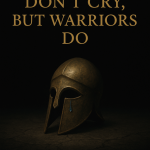
Somewhere along the line, we decided that crying is for the weak, sadness is shameful, and vulnerability is a glitch. “Cowboys don’t cry,” they said. “Tigers don’t cry,” as if anyone’s ever asked a tiger. You know this cliched phrase: “Man up. Take it like a man”,which, nowadays, apparently means: bottle it up, shut it down, and die early of a heart attack. Of course people will be shocked, asking, “What the hell happened to Joe?” and “He was so young, we had no idea he wasn’t OK!”’
Now, guys, to be clear,stoicism itself isn’t the villain. There’s strength and value in holding steady when the storm comes. But the rot set in when we turned stoicism into emotional neutering. A man who feels nothing is not a warrior,he’s just a broken machine with a beard,or some stubble.
This wasn’t always the case. And tell me if I’m wrong,but in ancient times, men wept.
They sank to their knees and let out ugly, snot-nosed sobs when their comrades fell.
They wrote epic laments,not tweets. They composed songs, they tore their tunics, and they howled into the night. Then they woke up the next day, strapped on a sword, and attacked enemies with fiery resolve. They were not weak. They were not fragile. They were whole.
When Patroclus, Achilles’ beloved companion, is killed, Achilles breaks down completely:
“A black cloud of grief shrouded Achilles. He poured dust over his head… and lay stretched out, tearing at his hair with his hands.”
He weeps, refuses to eat, and mourns before returning to battle with an unrelenting fury that changes the course of the war.
Egil Skallagrímsson, a fearsome Viking, composes the poem “Sonatorrek” (Loss of My Sons) after the death of his sons:“I would not weep, though weaponed men should hew me down; but I weep for my dead son…”
Biblical characters such as David were no strangers to weeping. The list is extensive.
Once I attended a specific support group for men, who sought to chat about the stuff that was making their lives difficult, and a newcomer asked, “Are we allowed to chat about the emotional stuff?”
The modern “stoic man” became a caricature,a cartoonish trope, a stereotyped character. Traits, like, emotionless, unshakable, distant,came not from the ancients. It happened later:
Victorian ideals of composure and reserve. Stiff upper-lip, my man!
World War I and II: where trauma (shell shock, PTSD) was dismissed as cowardice.
Mundane Media archetypes: cowboys, silent tough guys, John Wayne types.
SO…
1. Emotions aren’t weakness , repression is.
Bottling up your rage, grief, fear, or love doesn’t make you strong. It makes you a ticking time bomb with a fake smile.
2. Feel it, or be ruled by it.
If you don’t deal with your emotions like a man, they’ll twist you into something pathetic pretending to be powerful.
3. Real strength is feeling and acting anyway.
The warrior doesn’t cry instead of fighting , he cries and then fights harder. Tears aren’t surrender. They’re the rinse before the fight.
4. You’re not a robot, you’re a weapon with a soul.
Be fire, be fury, be grief, be love , all of it. That’s what makes you whole.
Matt
Discover more from MATTLR.COM
Subscribe to get the latest posts sent to your email.